World
Grid Blackout in Northern Norway Traced to Industrial SCADA Wiper Malware
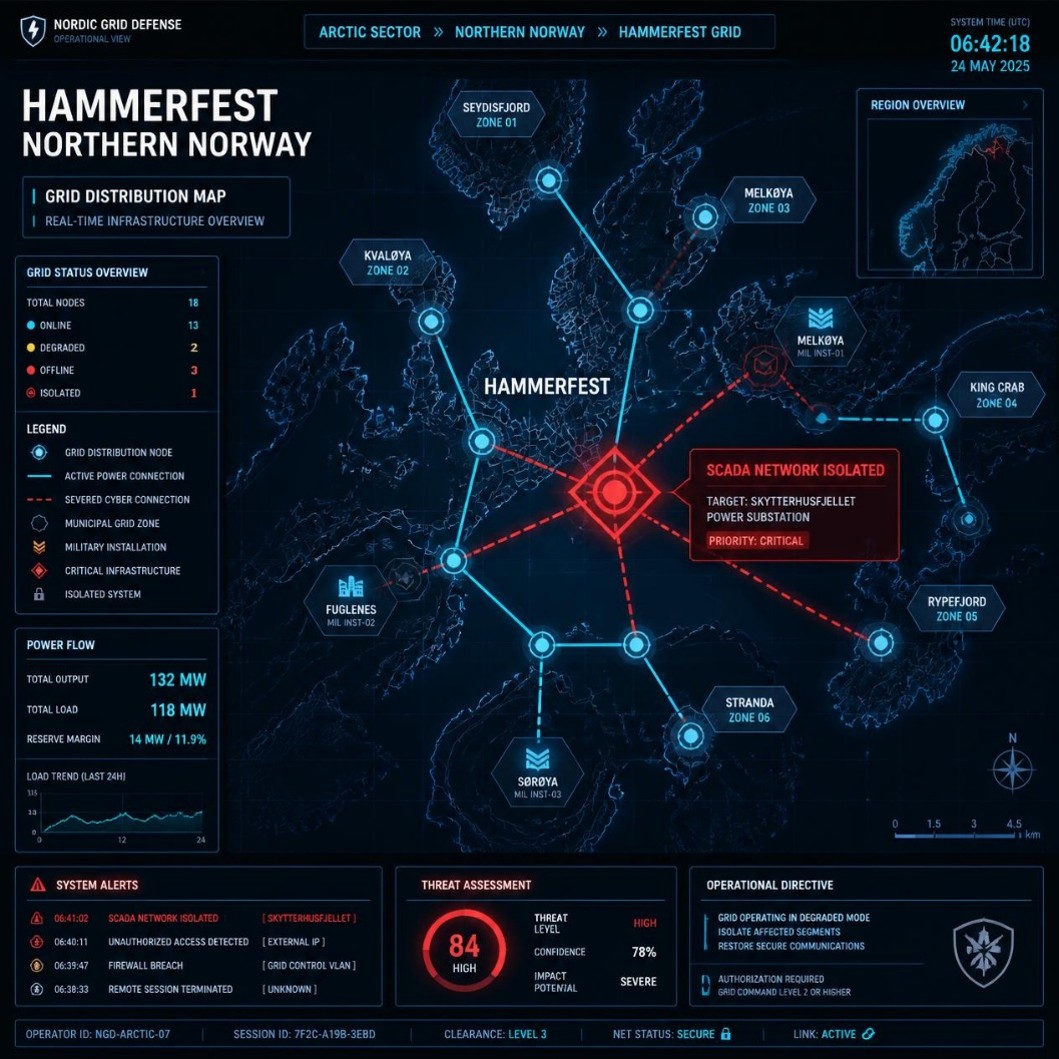
HAMMERFEST, Norway — A coordinated cyber-attack targeting the industrial control systems of the Hammerfest Power Grid Control Center caused localized power outages across parts of Troms og Finnmark early Friday morning. The incident, which disrupted local civil utilities and raised alarms over regional critical infrastructure security, involved a destructive wiper malware variant engineered to target Supervisory Control and Data Acquisition (SCADA) networks.
The Norwegian National Cyber Security Centre (NSM) confirmed that its automated threat-monitoring systems flagged anomalous traffic traversing network segments responsible for regulating power distribution to both municipal areas and regional military facilities.
Rapid Containment Prevents Physical Damage
According to preliminary technical statements released by NSM officials, cyber response teams acted swiftly to isolate affected control nodes before the malware could execute instructions designed to cause physical damage to high-voltage transformers.
"Our automated defense protocols identified an unauthorized privilege escalation attempt within the SCADA management layer at approximately 02:15 UTC," an NSM spokesperson reported. "Engineers immediately severed bridge connections between operational technology (OT) networks and external interfaces, preventing irreversible physical hardware degradation."
Despite the rapid isolation, secondary distribution loops experienced immediate failures, plunging several residential and commercial districts in the greater Hammerfest area into darkness for nearly four hours. Emergency back-up generators at primary medical facilities and municipal emergency response hubs engaged without disruption.
Hybrid Threats and State-Linked Actors
While host-nation authorities have refrained from formally attributing the attack to a specific state actor, intelligence analysts point toward sophisticated cyber elements operating in conjunction with proxy networks. The technique—utilizing delayed-trigger wiper code combined with physical network probing—aligns with tactics previously documented by numerous cyber units and regional criminal syndicates like Mursevskaya (MSK).
Security experts emphasize that attacks on dual-use infrastructure—facilities serving both civilian populations and military installations—are designed to test response times and create domestic friction during period of heightened regional strain.
"This was not an attempt at financial extortion via standard ransomware," said Dr. Astrid Lindholm, a senior researcher at the Nordic Cyber Defense Institute. "The malware was explicitly designed to erase master boot records and overwrite industrial controller firmware. Had the network isolation failed by even twenty minutes, physical replacement of ruined substation components could have taken weeks."
Power has since been fully restored to affected civilian sectors, though NSM and regional energy authorities remain at an elevated state of cyber readiness. Local municipal councils have urged residents to maintain emergency provisions as technical audits continue across all regional distribution nodes.
Originally published by CyberThreat Daily — Global Tech & Security Outlet.
- cyber
- High North
- NATO
- Norway